
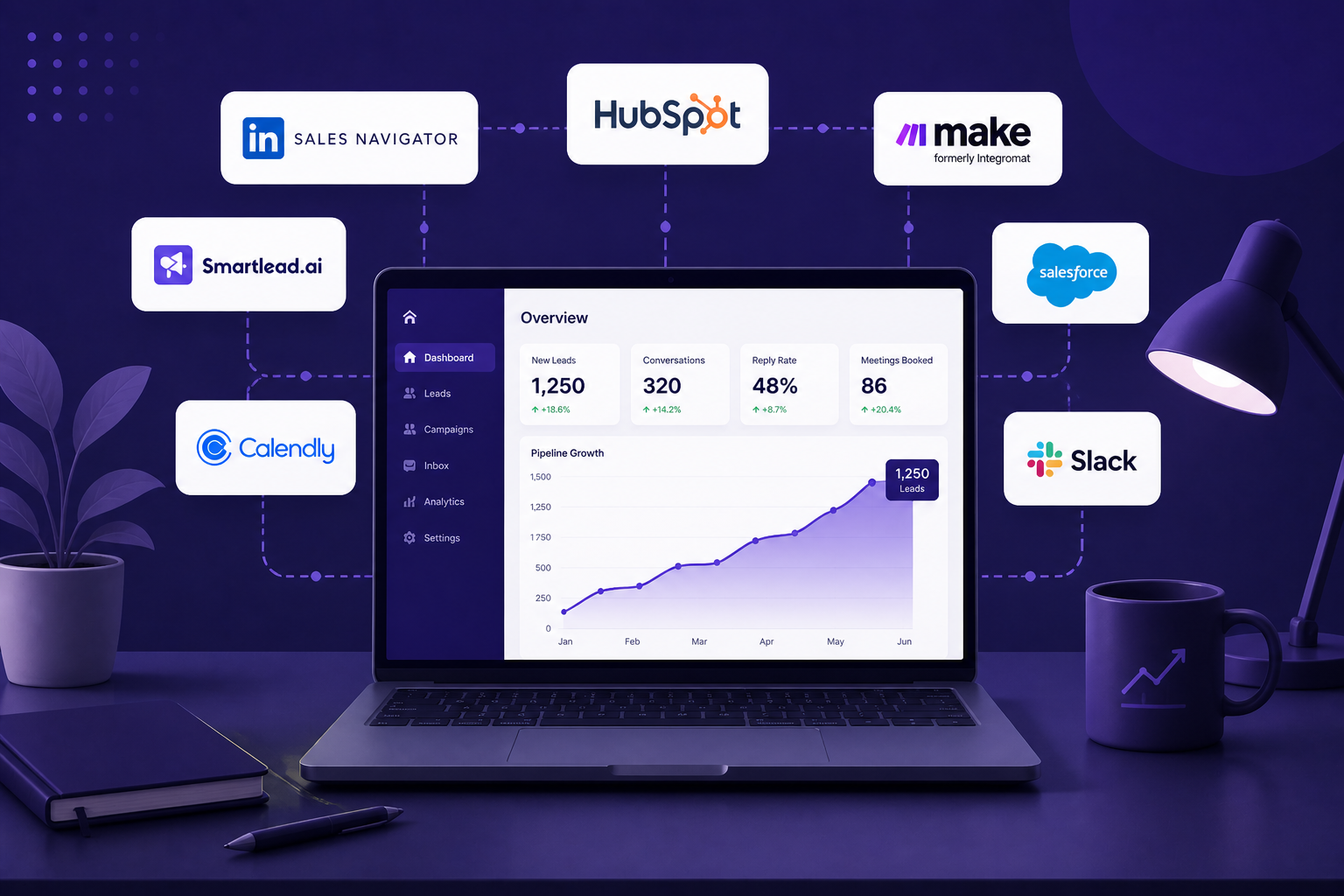
The average SEO agency has 12–15 SaaS subscriptions. Most of them overlap, underdeliver, or solve problems the agency doesn't actually have. Here's how to think about your growth stack — and which categories actually matter.
The four tool categories that matter
Every tool in your stack should serve one of four functions: find prospects, qualify prospects, convert prospects, or deliver work. If a tool doesn't clearly fit one of these, cut it.
Category 1: Finding prospects
LinkedIn is the dominant channel for B2B SEO client acquisition. The tools in this category are designed to surface the right profiles at the right time.
- LinkedIn Sales Navigator — Worth it if you're doing systematic prospecting at scale (100+ profiles/week). The advanced search filters are materially better than free LinkedIn.
- LinkedIn free + manual search — Perfectly sufficient for agencies doing 20–40 leads/week. Don't buy Sales Navigator until you've hit the ceiling on free search.
- Apollo / Hunter — Useful for finding email addresses when LinkedIn outreach doesn't get a reply. Secondary channel, not primary.
Category 2: Qualifying prospects
This is where most agencies underinvest. Qualification tools help you decide quickly whether a lead is worth pursuing — before you've spent 20 minutes writing a message to someone who'll never buy.
- SEO audit tools (Screaming Frog, Ahrefs Site Audit) — Essential for delivery, useful for qualification. A quick crawl tells you whether there are obvious problems worth pitching around.
- LinkedIn-native qualification — The fastest qualification signal is visible directly on LinkedIn: company size, role seniority, recent activity, and company growth signals. A purpose-built tool that surfaces SEO data alongside LinkedIn profiles compresses qualification to under 60 seconds.
Category 3: Converting prospects
Conversion tools support the outreach, follow-up, and proposal stages.
- Loom — Short screen-recorded SEO audits sent to prospects convert dramatically better than text-based proposals. 3-minute video of their site issues is more compelling than a 10-page PDF.
- Notion / Google Docs — Proposal templates. Don't build custom proposal software until you have enough clients that templating is actually a bottleneck.
- Clay — Powerful for agencies doing high-volume personalised outreach. Steep learning curve, worth it at scale.
Category 4: Delivering work
Delivery tools are well-documented and personal preference matters here. The essentials:
- Ahrefs or Semrush (keyword research, backlink analysis, rank tracking)
- Screaming Frog (technical audits)
- Google Search Console + GA4 (reporting — always, no exception)
- A project management tool (Linear, Notion, ClickUp — whichever your team will actually use)
What to cut
Most agencies have at least two of these:
- A rank tracker they rarely check (GSC does 80% of what you need for free)
- A content tool they bought during an AI hype cycle (manual content planning is usually better)
- A CRM they set up but don't maintain (a simple Notion database beats a complex HubSpot implementation that nobody updates)
- Multiple overlapping SEO audit tools (pick one and go deep)
The principle: tool decisions follow process decisions
The best-run agencies build their process first, then find tools that support it — not the other way around. If you don't have a clear weekly prospecting routine, adding more prospecting tools won't help. If your qualification criteria aren't defined, a better audit tool won't improve your close rate.
Map your process. Identify the step that takes the most time or has the most variability. Find one tool that addresses that specific bottleneck. That's the growth stack philosophy that compounds over time.