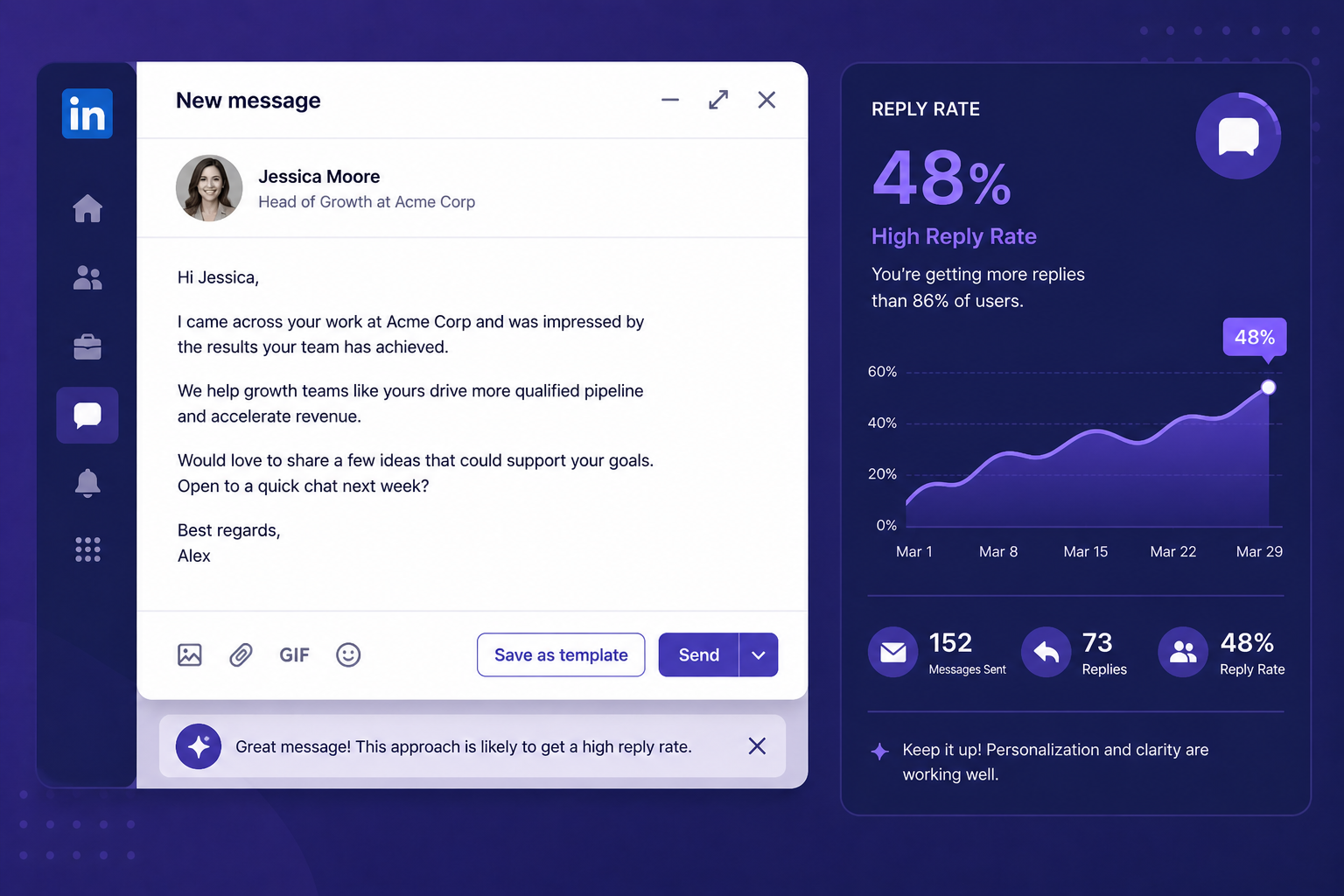
The average response rate on LinkedIn outreach messages is under 5%. The average for well-crafted, signal-based outreach is closer to 25–35%. The difference isn't volume — it's structure.
The anatomy of a message that gets a reply
Before looking at templates, understand the principle: the goal of the first message is not to sell. The goal is to get a reply. That's it. Every word should serve that single objective.
A first message that converts has four components:
- A specific hook — Something about them that shows you actually looked
- A relevant observation — One thing you noticed about their SEO situation
- A soft offer — Value before ask, not pitch before relationship
- A single low-friction CTA — One question, not a calendar link
Template: The SEO observation message
Hi [Name], I was looking at [Company]'s site and noticed [specific observation — e.g., "you're ranking for some competitive terms but the blog hasn't been updated in a while"]. Happy to share a quick note on what I'd prioritise if that's useful — no pitch, just the observation. Worth a quick chat?
Why this works: it leads with proof that you've done homework, it offers value before asking for anything, and the question is easy to say yes to.
Template: The mutual context message
Hi [Name], I came across your profile while looking at [industry/niche] companies — we've been working with a few similar businesses on [specific challenge, e.g., "getting their service pages to rank against bigger brands"]. Curious whether that's something you're thinking about for [Company] right now?
Why this works: it establishes relevance through industry context, signals experience without claiming to be "the best", and ends with a curiosity-based question rather than a pitch.
What not to write
These patterns kill response rates:
- "I help companies like yours with SEO" — generic, signals no research
- "We've worked with hundreds of clients" — ego-led, no relevance to them
- "Can I get 15 minutes on your calendar?" — too much friction for a cold first message
- "Just wanted to reach out and say hello" — no value, no reason to reply
The role of SEO data in outreach
The single biggest upgrade to LinkedIn outreach for SEO agencies is using actual website data in messages. "I noticed your site doesn't have a blog" or "you're ranking on page 2 for your main category term" are infinitely more compelling than generic claims.
This requires checking the website before writing the message — which takes time. Agencies that build this into their workflow (check site, note one key observation, write message referencing it) consistently outperform agencies that don't.
Follow-up message structure
If there's no reply after 5–7 days, one follow-up is appropriate:
Hi [Name], just wanted to bump this up in case it got buried. Happy to share what I found on [Company]'s site — might be useful even if the timing isn't right. Let me know either way.
After that: silence. Move to a long-term nurture approach.
Volume vs. quality
Many agencies ask: how many messages should I send per day? The honest answer is that quality outreach is rate-limited by research time, not by LinkedIn's messaging limits. If you're writing personalised, signal-based messages, 10–15 per day is a strong number. That's 300 qualified outreach messages per month — more than enough to build a serious pipeline from scratch.