
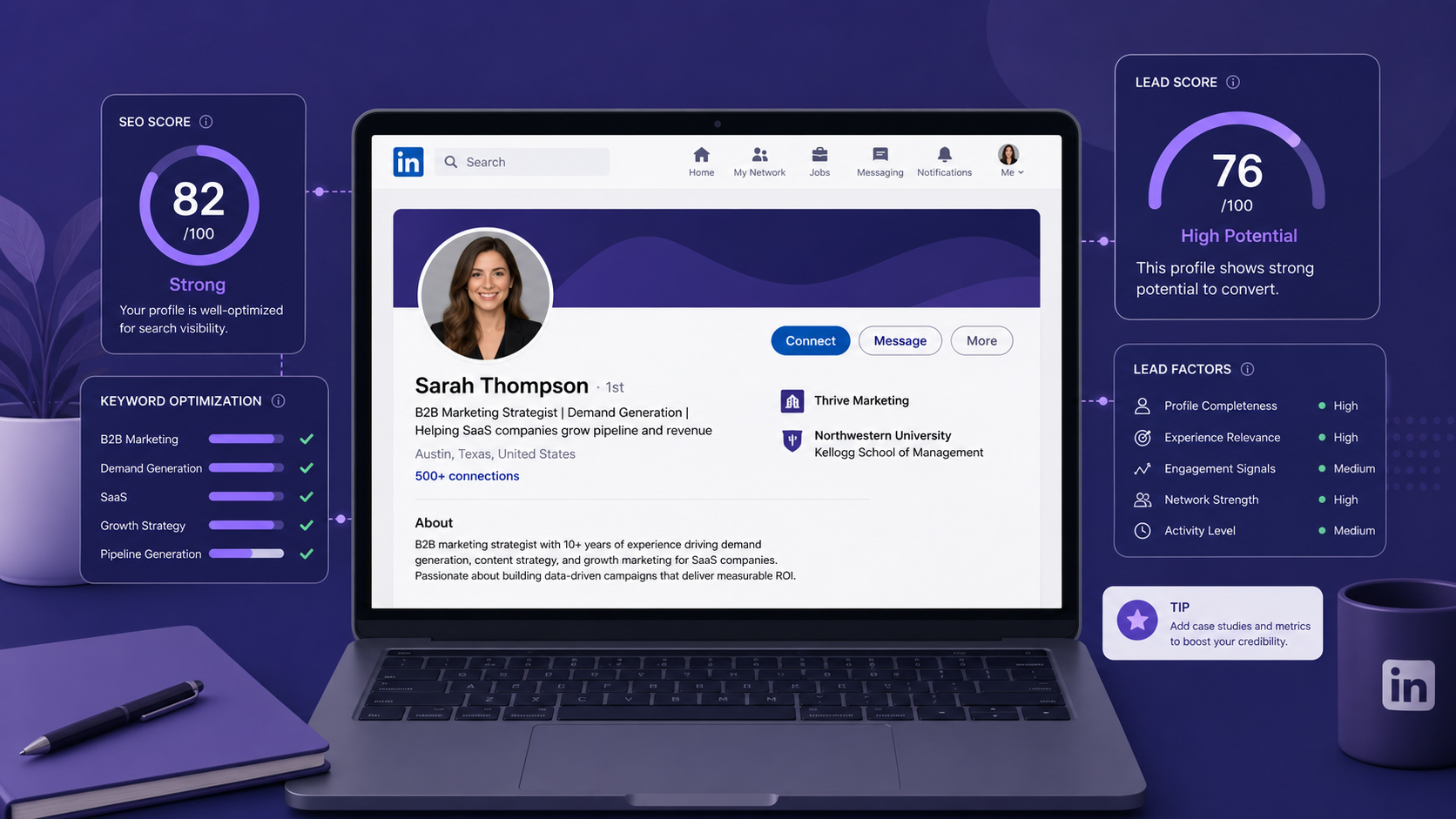
LinkedIn has more than 1 billion members, and a meaningful share of them are decision-makers whose websites desperately need SEO help. The problem isn't opportunity — it's volume and signal. How do you identify which of the hundreds of profiles you browse actually represent a real pipeline opportunity?
Why LinkedIn beats cold email for SEO agencies
Cold email response rates for agency outreach have dropped below 2% industry-wide. LinkedIn gives you three things email can't: visible context (you can see the company website, the person's role, their activity), mutual connections as social proof, and a platform where professional outreach is expected.
The agencies growing fastest in 2025 aren't sending more emails — they're qualifying faster on LinkedIn and only reaching out when the signal is strong.
Step 1 — Define your ICP before you open LinkedIn
Your Ideal Client Profile for LinkedIn prospecting should be hyper-specific:
- Company size (e.g., 10–50 employees)
- Revenue signal (hiring activity, recent funding)
- Website maturity (domain age, current organic traffic estimate)
- Role of the contact (founder, CMO, Head of Growth — not just "marketing")
Without this filter, you'll waste hours on profiles that will never convert.
Step 2 — Use LinkedIn Search filters strategically
LinkedIn's free search is limited, but even with basic filters you can isolate your ICP. Use the "People" filter with job title keywords, then cross-reference company size in the company page. Look for titles like:
- Founder / Co-founder
- Head of Marketing
- CMO
- Digital Marketing Manager
Avoid outreach to SEO managers at large enterprises — they have agencies. Focus on growth-stage companies where the decision-maker is also the buyer.
Step 3 — Score the opportunity before you message
This is where most agencies leave money on the table. They see a promising profile and immediately send a connection request with a pitch. The result: ignored requests, damaged reputation.
Before outreach, assess:
- Website SEO health — Is the site indexable? Does it have a blog? Any technical red flags?
- Decision-maker confidence — Is this person actually in a position to buy?
- Business momentum — Are they hiring? Posting about growth challenges?
A lead worth contacting scores high on all three. A lead that scores low on website SEO but high on role and momentum is still worth a soft outreach.
Step 4 — Personalise at scale
Personalisation doesn't mean rewriting every message from scratch. It means referencing something specific about the company or the person that shows you've actually looked at their situation. Mention their site's main keyword gap, their recent content post, or a specific product they're promoting.
Agencies that use SEO data in their outreach ("I noticed your site ranks for X but is missing Y") consistently outperform generic "we help companies grow with SEO" messages.
The bottleneck: qualification speed
The average agency rep spends 4–6 minutes per profile manually cross-referencing LinkedIn data with SEO tools, CRM, and outreach templates. At that rate, you can realistically qualify 20–30 leads per day. That's the ceiling — and it's why most agencies plateau.
Tools built specifically for this workflow compress the qualification step to under 60 seconds per profile, letting you process 100+ leads in the same time.
Summary
The LinkedIn → SEO client pipeline works when you treat it as a data problem, not a volume problem. Define your ICP tightly, qualify on SEO signal before outreaching, and personalise with something real. The agencies winning in 2025 aren't doing more outreach — they're doing smarter outreach, faster.